
The Cars
Cars
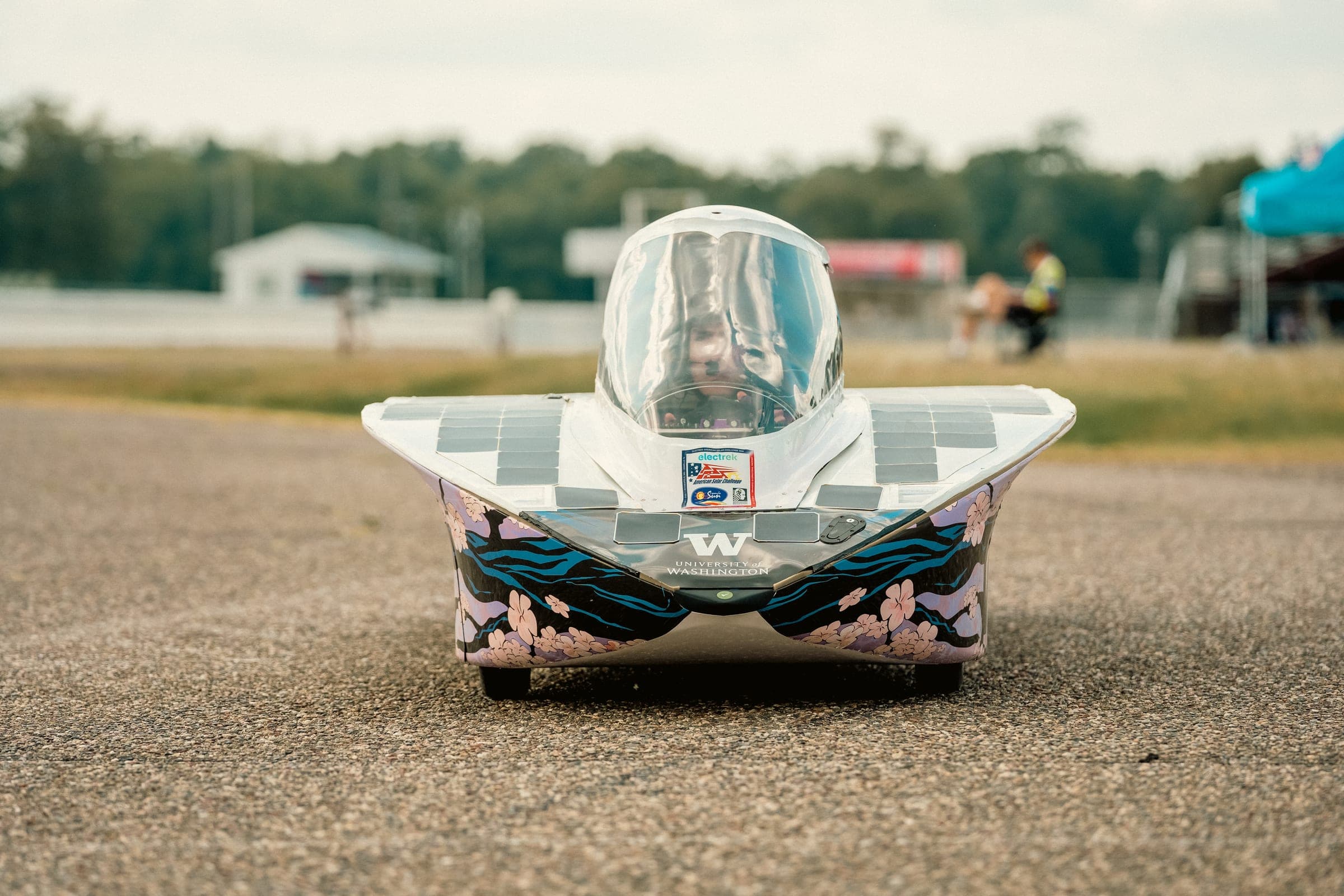
Sakura
2026 American Solar Challenge · 4th in SOV class · #1 American SOV team
Sakura is named for the cherry blossoms at UW, and it is the first car this team has built from the ground up. A rule change lifting the allowed solar array area from 4 m² to 6 m² forced a full redesign, and the answer was a three-wheeled bullet body carrying 386 cells over a carbon sandwich chassis. It was powered on for the first time the day before it was trailered to the Formula Sun Grand Prix, then drove more than 2,500 miles across two competitions without a single major failure.
386 Maxeon cells at 25.6% efficiency across 6 m², assembled by students, peaking at 1,540 W. The array tilts to chase a low sun.
A 36S9P pack of Samsung 45T lithium-ion cells, about 50 lb, running 96V to 151V. Enough to power an average toaster for about 5 hours.
A Mitsuba hub motor rated at 2 kW and peaking at 5 kW, driven by a KLS 8080N controller. Highway capable at 65 mph.
A three-wheeled bullet body developed over multiple CFD iterations, on a carbon sandwich panel chassis with a steel roll cage.
Without a driver. 636 lb with driver and ballast aboard.
Full Specification
Solar Array
- Cells
- 386 Maxeon
- Cell efficiency
- 25.6%
- Array area
- 6 m²
- Peak power
- 1,540 W
- Strings / MPPTs
- 4 / 4
- Array
- Tiltable
Battery & Electrical
- Chemistry
- Lithium ion, Samsung 45T
- Capacity
- 5.25 kWh
- Voltage
- 96V – 151V
- Configuration
- 36S9P
- Pack mass
- ~50 lb
- BMS
- Custom, designed in house
- Telemetry
- 90+ readings, one CAN frame per second
Motor & Drivetrain
- Motor
- Mitsuba hub motor
- Rated power
- 2 kW
- Peak power
- 5 kW
- Controller
- KLS 8080N
Aerodynamics & Body
- Drag (CdA)
- 0.079
- Wheels
- 3
- Body
- Bullet shape, multiple CFD iterations
- Chassis
- Carbon sandwich panel
- Safety structure
- Steel roll cage
Mass & Dimensions
- Mass, no driver
- 460 lb
- Mass, driver + ballast
- 636 lb
- Length
- 5.7 m
- Width
- 1.5 m
- Height
- 0.9 m
- Ground clearance
- 3 in
Suspension, Steering & Brakes
- Front
- Double wishbone
- Rear
- Swing arm
- Steering
- Manual, 14.9 m turning radius
- Brakes
- Hydraulic, regenerative as redundancy
- Tires
- Bridgestone Ecopia
- Rolling resistance
- 0.0065
Performance
- Top speed
- 65 mph, highway capable
- Race average
- 30 mph across both competitions
- Range, battery only
- 178 miles
- Range, clear day
- 466 miles
- Efficiency
- 29.8 miles per kWh
Cockpit
- Vision
- Front window, plus a backup camera on a cockpit display
- Displays
- Steering wheel mounted, side dashboard for power on
- Cooling
- One cooling hole and a driver fan
- Egress
- 4.2 seconds
- Comms
- Baofeng UV-5G radio to the caravan
How It Gets Built
Every system on this car is designed by students, and most of it is built by them too.
Design starts in October and freezes in December. A rolling chassis is standing by February, then a long wait on parts through June, and the whole car goes together in roughly a month.
The largest line items are the aeroshell, the solar array and the battery cells.
Built in house
- All design work
- The chassis
- All wiring
- Solar array assembly
Outsourced
- The aeroshell
- Suspension parts
- PCB fabrication — every board is student-designed, then manufactured externally
Purchased
- Solar cells
Every circuit board on the car is student-designed: high-voltage power distribution, telemetry, driver interface, drivetrain control, lights and the steering wheel.
The 2025 car
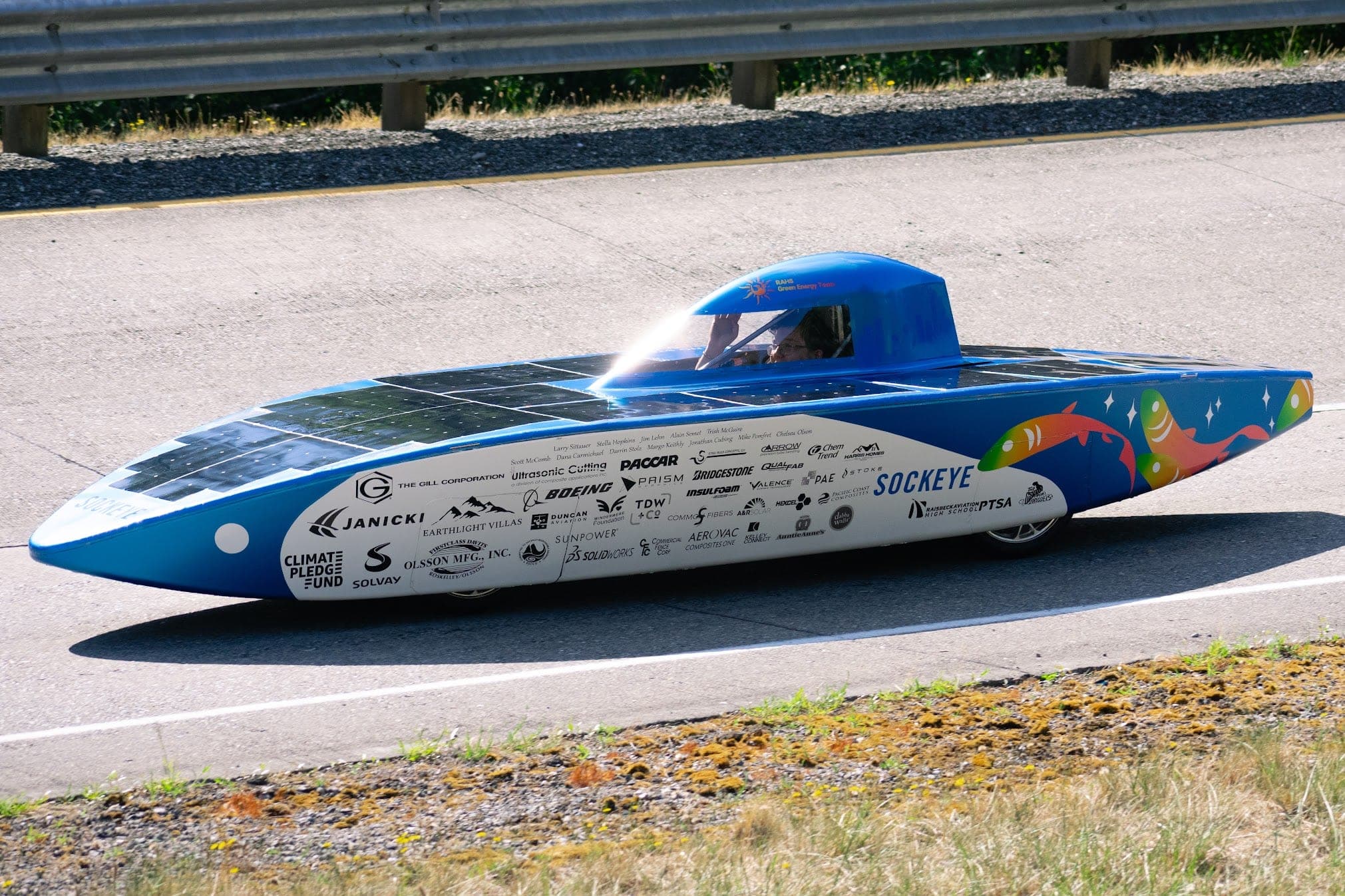
Sockeye
2025 Formula Sun Grand Prix · 6th in SOV class · Rookie of the Year
Sockeye raced the 2025 Formula Sun Grand Prix, finishing 6th in the Single-Occupant Vehicle class and winning Rookie of the Year in the team's first competition. Sakura carries a similar chassis design forward; the suspension, aeroshell, electrical system and solar array are all new.
Help Us Build The Next One
The chassis needs repairing and the electrical system is being rebuilt from the ground up. That takes hands on the shop floor and partners behind the budget.
Get Involved