
Who We Are
About
A student engineering collective built around one car and one deadline.
Our Mission
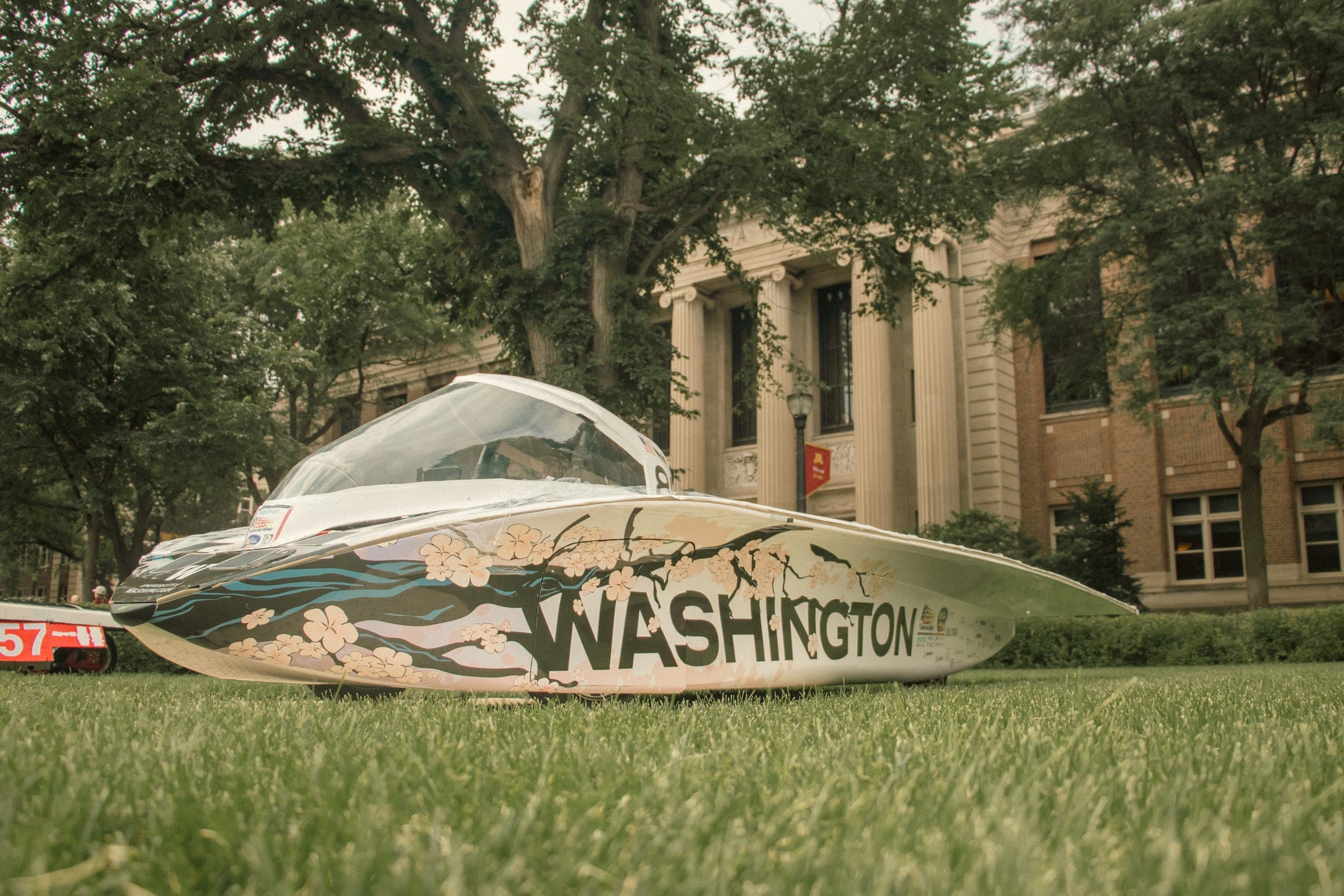
Washington Solar Car exists because we believe students grow most when working alongside others toward something bigger than themselves. That belief takes shape through the demanding work of designing, building, testing, and preparing a solar car to race against teams from around the world. Along the way, members discover what it means to lead, to trust teammates, and to push through hard problems together, lessons that shape who they become long after graduation. Every race is a reminder that the work matters, that sustainable transportation is worth fighting for, and that real change starts when people commit to building something together.
Why Solar
Solar is the hardest version of the problem. A car that makes its own power has no margin for a lazy design decision, so every choice a student makes here gets tested against physics and then against a thousand miles of highway.
That is the point. Students on this team design real parts, machine them, wire them, and then watch them either hold up or fail in front of everyone. Few places in an undergraduate education give you a deadline that a competition sets and a result you cannot argue with. The sun is what makes the problem honest.
What Makes Us Different
Founded just three years ago, few people were willing to buy into an unproven dream. Washington Solar Car built its first car in an eleven month design cycle, less than half the typical two years most teams take. That team earned Rookie of the Year, then followed it up the next year by placing as the top American team in their first cross-country endurance race. When the car needed a trailer to haul it cross-country, or funding fell short, the community stepped up every time, and that community is the real strength behind everywhere this team has gone.
Electrek American Solar Challenge 2026
4th in the SOV class, and the top American team in the Single-Occupant Vehicle class
Minneapolis to Amarillo, down the Great River Road and Route 66. 29 SOV teams entered. 25 made it onto the track, 13 qualified for the American Solar Challenge, and 4 completed the whole race.
Base route 1,547.0 miles plus a 217.4 mile loop, less 15.0 miles of deductions.
Stage by stage
- Stage 14th787.1 miles · Zero deductions
- Stage 24th411.3 miles
- Stage 35th400.4 miles
- Stage 4150.6 miles · 41.5 mph average
Ahead of us
- KU Leuven, Belgium
- TU Delft, Netherlands
- ÉTS Montréal, Canada
We were the only American SOV team to complete the entire base route. Every other American SOV team trailered to a checkpoint.
At the 2026 Formula Sun Grand Prix qualifier we placed 4th in the SOV class over 271 laps, with a fastest lap of 3:44 on a 3.1 mile track.
How It Actually Went
Five minutes to spare
The electrical team had been fighting problems with the battery management system, where the isolated amplifiers used for current sensing were failing at random. Everything had been repaired and the car reached BMS scrutineering the day before the race. During testing, all of the amplifiers failed at once.
A competing team gave them a spare hall effect sensor. The electrical team piled into a truck with the battery, drove back to camp, jerry-rigged the hall effect sensor into the BMS, and recalibrated the system. The modified system went back to scrutineering and passed. The car went straight to dynamics testing and cleared U-turn, figure eight, slalom, and brake testing without a hitch. They finished with about five minutes to spare, the last team to qualify before the race began.
Then it just kept going
The car was powered on for the first time the day before it was trailered to the Formula Sun Grand Prix. It then drove over 2,500 miles across FSGP and ASC combined and completed both competitions without a single major failure.
Better than last year
- Fewer electrical faults. The 2025 car would shut off whenever the horn was used.
- Onto the track on time. In 2025 the team was held up in scrutineering and only got a few laps on day one.
- A battery 50% larger than the 2025 car's.
- An array producing about 70% more energy than the 2025 car's.
Being fixed for next season
- A major crack in the carbon fiber chassis near the suspension is being repaired. ASC road conditions were far worse than anticipated and stressed the chassis.
- The electrical system is being rebuilt from the ground up to improve efficiency, increase motor performance, and expand car control.
By The Numbers
The Season
The Car
The Team
Our Legacy
Founded
Washington Solar Car starts, with few people willing to buy into an unproven dream.
The Race
The American Solar Challenge is a cross-country, rally-style endurance race for solar cars. The 2026 route ran from the University of Minnesota in Minneapolis, down the Great River Road and Historic Route 66, to Amarillo, Texas. 2026 is Route 66's 100th birthday and the race was an official Centennial project.
The Qualifier
The American Solar Challenge is preceded by the Formula Sun Grand Prix, a multi-day closed-track qualifier. A team has to get through it to start the cross-country race at all.
Where We're Headed
Looking ahead, we hope to build a lasting legacy, a foundation strong enough to give generations of students after us the same hands-on experiences and learning opportunities that shaped us. As we grow, learn, and sharpen our craft, our sights are set on preparing to race at the Bridgestone World Solar Challenge in Australia, the most demanding solar race. Until then, we will continue to master the American Solar Challenge and the Formula Sun Grand Prix, treating every competition as a chance to push our engineering further, develop stronger engineers, and lay the groundwork for the team that shows up in Australia.
Join the Team